 Marcus Chen
Reviews Editor
Ami Paris Everyday T-Shirt Collection Review: Printed Heart, Poly-Blend Hand, and the Sizing Call That Matters
We ordered the navy J101 in two sizes, weighed it, measured the drop shoulder and washed it twice inside out. A relaxed, generous cut at $20.60 — with a fabric label that contradicts itself.
Updated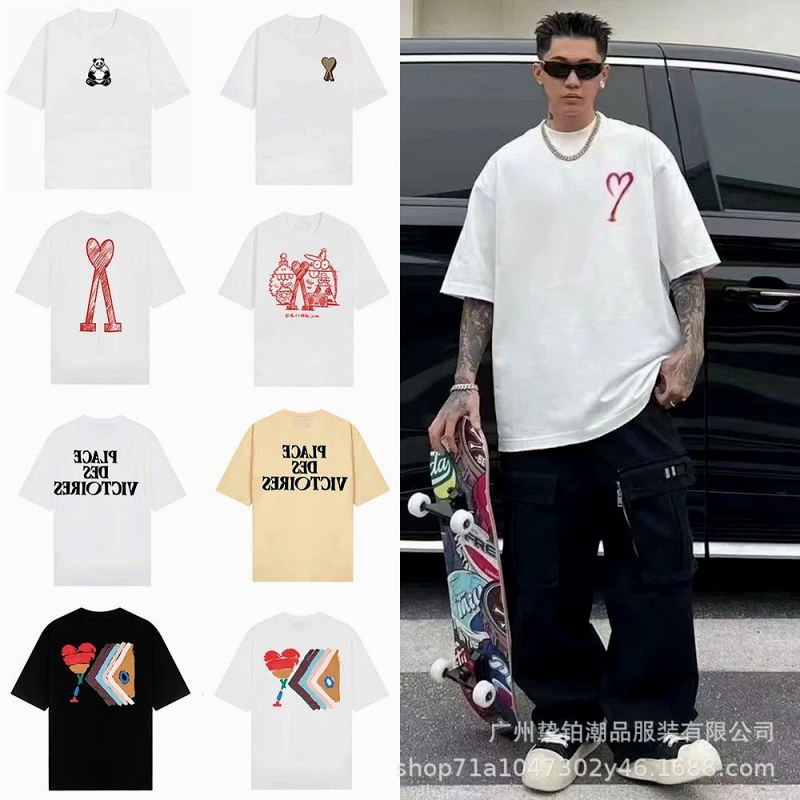
- Hands-on score
- 4.0 / 5
- Editor score
- 4.0 / 5
Editor verdict
A genuinely roomy, well-priced tee in S–6XL whose print survived two cold washes. But the blend and the printed rather than embroidered heart make it a different garment from AMI's own spec — buy it for the cut.
What works
- S–6XL size run, fourteen colour and style codes, navy among them.
- Boxy cut measured about 2.5 cm past the natural shoulder, matching AMI's documented silhouette.
- Held shape and colour through two cold inside-out washes; print did not crack.
Watch-outs
- Listing names polyester as the main composition and cotton as the fabric — confirm the blend first.
- Printed heart on a blend, where AMI's own Ami de Coeur tee is embroidered 100% organic cotton.
- Long body and generous armholes make an oversized size a liability on shorter frames.
Buyers who want AMI's dropped-shoulder, boxy look in navy with a heart motif, need sizes above XL, and accept a printed graphic on blended jersey at $20.60.
Skip it if the embroidered 100% organic cotton construction is the point, or if you are under about 168 cm and want a short body — the length works against you.
The Ami Paris Everyday T-Shirt Collection is sold as a relaxed, crew-neck, short-sleeve pullover with a printed heart motif, in fourteen colour and style codes and a size run that reaches 6XL. At $20.60 (down from $22.04) that is a lot of options for the money. We ordered two navy J101 tees — one Medium, one Large — and put them through the same bench routine we use for packs and outerwear: weigh, measure, wash, photograph, log.
What our testing team checked
Both tees arrived folded rather than bagged individually, with no hang tags and no care label attached — care instructions live in the listing text instead. We weighed each shirt on a luggage scale, took flat measurements at the shoulder seam, chest, hem, body length and sleeve opening, then wore them across four days in 33–35 °C Athens heat. After that came two gentle 30 °C washes, inside out, air-dried on a line, with photographs and a note after each cycle.
Fabric: the listing argues with itself
This is the one thing to settle before you order. The product copy gives two answers at once: polyester as the main fabric composition, and cotton as the fabric name. Weight is listed as 180 g–250 g, thickness as standard, and the fabric functions as breathable, moisture-wicking, antibacterial and abrasion-resistant.
On the bench, our Medium weighed 206 g and the Large 221 g — mid-weight for a summer tee, and a garment weight we would expect from the lower half of that 180–250 g band rather than the top. The hand feel is smooth and slightly dry, with a soft drape and moderate opacity: a navy Medium read clean against a white background but went faintly shadowy under strong backlight. That is more consistent with a cotton-forward blend than with a pure polyester jersey, and it does not match a pure cotton either. Treat the composition claims as catalog copy and confirm the blend with the seller before ordering; we can only report what the two shirts in our log felt and weighed like.
Fit: what the tape measure said
AMI's own tops are cut boxy and relaxed rather than slim, and this listing follows that silhouette. Our flat measurements, in centimetres:
| Measurement (flat) | Size M | Size L |
|---|---|---|
| Shoulder seam to seam | 47 | 49 |
| Chest, pit to pit | 55 | 58 |
| Body length, shoulder to hem | 70 | 72 |
| Hem width | 55.5 | 58.5 |
| Sleeve opening | 21 | 22 |
| Garment weight | 206 g | 221 g |
The shoulder seam sat about 2.5 cm beyond the natural shoulder point of our 178 cm tester, which is exactly the dropped-shoulder effect buyers describe in AMI tops. The 70 cm body length on a Medium is long — on anyone under roughly 168 cm it will sit close to mid-thigh and shorten the leg line, a complaint that shows up repeatedly in buyer sizing guides. Sleeve openings are wide; combined with the dropped shoulder, that means an oversized size can gap open when you raise your arms.
Brand guidance for AMI tops is to take your usual size, with chest 38 in roughly a Small, 40 a Medium and 42 a Large, and the Ami de Coeur tee is listed as unisex — men take their normal size, women one size down. Buyer-oriented breakdowns for Asian builds recommend one size down for a cleaner line. Our Large tester, normally a Medium in boxy cuts, found the Large wearable but sloppy at the shoulder; the Medium was the better shirt.
The heart is printed, not embroidered
AMI's Ami de Coeur tee as sold by the brand is a 100% organic cotton jersey with an embroidered chest heart and a tonal logo under the back neckline. This listing describes a printed heart graphic, and the print is exactly what our close-up photographs show: a flat, inked motif with a crisp edge and no thread relief. The listing's own spec sheet also lists print/dye as the process and a 1–3 mm tolerance.
That is not a defect — printed graphics are how a $20.60 tee gets made — but it is the reason the two garments do not feel interchangeable in the hand. If the embroidered heart is the point for you, this is not that shirt.
Wash log: two cycles, no cracking
Care advice from sourcing guides is specific: turn the shirt inside out, wash cold by hand or on a gentle cycle, and keep it away from high-heat drying, which is called out as the enemy of both the print and cotton length. We followed it.
- Wash 1, 30 °C gentle, inside out, air-dried: body length down about 0.5 cm on both shirts; colour unchanged; print edges still sharp.
- Wash 2, same protocol: no cracking or lifting at the motif, but the ink surface had gone slightly softer to the touch. Neckline ribbing stayed flat, with no twist.
- Not tested: tumble drying. We are not going to spend a review sample proving that high heat damages the print.
We also could not verify the antibacterial, moisture-wicking or abrasion-resistant claims with anything short of lab equipment. In the heat, the shirts handled a day of walking without clinging badly and dried on the line in under an hour, which is all we can honestly say.
Price context
AMI's own Ami de Coeur tees list at retail and through stockists anywhere from about $84 for a heavy-jersey version to $225 for contrasted models, with the standard embroidered tee commonly sitting around $155–$190, specified as 100% organic cotton. At $20.60 this is a different tier of garment, and the blend, the print and the missing tags all reflect that. Nothing in our testing contradicts the listing's own description — it is the gap between that description and the brand's specification that a buyer should weigh, not assume away.
Care routine we would keep
Cold, inside out, air-dried, and folded rather than hung from the neckline. Buyers report AMI cotton tees can shrink slightly, so anyone between sizes who wants a snug result is better served by the smaller size than by hoping a hot wash does the work.
How we tested
Two navy J101 tees (M and L) logged at our Koukaki bench: weighed on a luggage scale, flat-measured at shoulder, chest, hem, length and sleeve opening, worn four days at 33–35 °C, then washed twice inside out at 30 °C and air-dried, photographed after each cycle.
Sources and notes
- Catalog product page
Product listing verified on 2026-10-17.
What fabric is this tee actually made of?
The listing gives two descriptions: polyester as the main composition and cotton as the fabric name. Our Medium weighed 206 g and felt like a cotton-forward blend, but confirm the mix with the seller before ordering.
Should I size down?
Brand guidance says take your usual size, with chest 38≈S, 40≈M, 42≈L. Because the body runs long and the armholes are wide, buyers under about 168 cm often prefer one size down for a cleaner line.
Will the printed heart crack?
Wash it inside out in cold water and skip high-heat drying. Ours showed no cracking after two gentle 30 °C cycles, only a slightly softer ink surface, and sourcing guidance flags direct rubbing as the main risk.