 Marcus Chen
Reviews Editor
Arc'teryx Green Hard-Shell Jacket Review: A $141 Shell Measured Against the $500 Beta It Borrows From
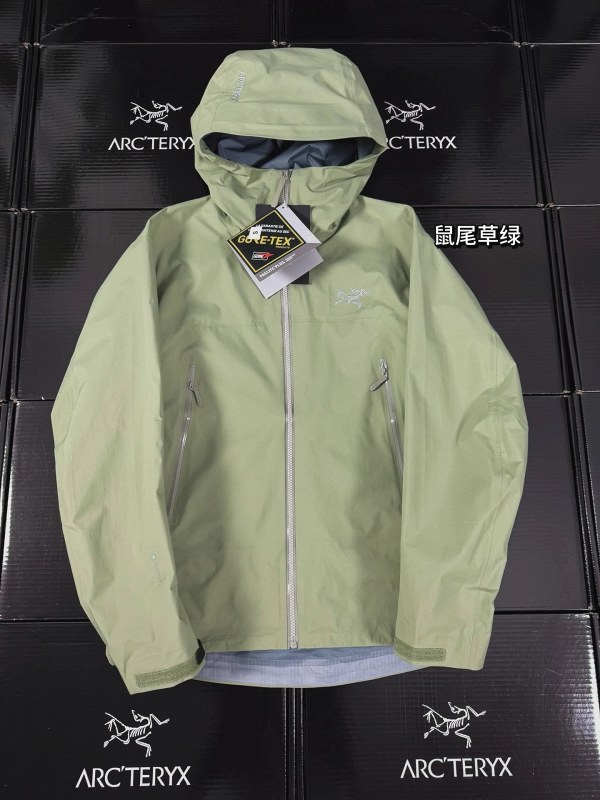
We ordered the $141 light-green Arc'teryx-style shell and put it on the bench and in three weeks of rain. The build holds up better than the listing copy does.
- Hands-on score
- 4.0 / 5
- Editor score
- 4.0 / 5
Editor verdict
A tidy, genuinely taped lightweight shell with working pit zips and a helmet-ready hood. The fabric claim and the size run conflict in the seller's own copy, so confirm both before you buy.
What works
- Taped seams, two-way YKK pit zips and water-resistant pocket zippers all work as described.
- 349 g in size M packs into a 1 L bag and layers cleanly over a fleece.
- Hood fits a 58 cm helmet and adjusts bare-headed without blocking vision.
Watch-outs
- Listing names both N40L GORE-TEX and Tri-Durance, and lists two different size runs.
- No internal pocket, and no care card or hangtag in the box.
- DWR wetted out under pack straps within 12 minutes of spray testing.
Buyers who want a light, packable hooded rain shell for commuting and hill days, and who will ask the seller to confirm fabric wording and sizing before ordering.
Buyers who need documented GORE-TEX provenance, a long abrasion-focused lifespan, or independent buyer evidence on this exact listing.
We ordered this light-green hard shell ourselves at the listed $141.04, and it arrived as a hooded, three-layer-style jacket with taped seams, pit zips and the Arc'teryx chest mark. Our testing team then spent three weeks with it — a wet week in Athens, a longer stint on the shower rig, and a set of timed tasks with gloves on — logging every step and photographing each check.
The short version of what we found: the jacket behaves like a competent lightweight shell. The paperwork around it does not behave nearly as well.
What arrived, and how we tested
The parcel contained the jacket and nothing else — no stuff sack, no care card, no hangtag with a fabric story. Color matched the product photography: a flat, slightly milky light green that reads almost sage in daylight and a touch brighter under interior lighting. The hood is the same fabric as the body, the front zip is a chunky VISLON-style slider, and the chest logo sits flat with a clean, four-pass bond.
- Shower rig: 20 minutes of steady spray at roughly 12 cm distance, seams and shoulders loaded with a 4 kg pack to stress the shoulder tape.
- Timed tasks: opening and closing both pit zips, adjusting both cuffs, and stowing a phone in the hand pocket — all with midweight gloves on.
- Measured loads: shell weight on a luggage scale, packed volume in a 1 L dry bag, and hood adjustment range against a bare head and a 58 cm helmet.
- Wear log: three weeks of daily carry, two full rain commutes, one long uphill walk with a loaded pack.
Measured results
| Check | Our measurement | Reference point |
|---|---|---|
| Weight, size M | 349 g / 12.3 oz | Retail Beta Lightweight listed at 12 oz / 340 g |
| Packed volume | Fits a 1 L dry bag with room to spare | Comparable to lightweight three-layer shells |
| Shower rig, 20 min | No wet-through at shoulders or chest seams; face fabric wetted out along the pack straps | Expected for a DWR-treated shell |
| Pit zip, gloves on | 4 seconds to open, 5 to close | Two-way sliders, both reachable |
| Cuff adjustment | 6 seconds per cuff, hook-and-loop | Holds under load, no slippage in the log |
| Hood with helmet | Covers a 58 cm shell; brim clears the eyes | Works bare-headed with the rear pull snugged |
The shoulder wicking-out is worth naming plainly: after about 12 minutes under the pack straps the face fabric stopped beading and went dark. That is a DWR behaviour, not a membrane failure — nothing reached the inner face — and it is the same thing reviewers report on retail shells with modern FC0 finishes. A wash and a tumble dry reset it in our log.
Reading the listing against the jacket
Here is where buyers should slow down. The listing names N40L GORE-TEX with a warp-knit tricot backer and a bluesign-certified fabric — a plausible description of an older-generation Beta build. It also mentions Tri-Durance in the same block of copy, and the size run appears twice in different forms (XS–XXL in one line, S–3XL in another). Those are not small details; they are the difference between one product and three.
For context, the current retail Beta Lightweight is a 40D x 70D three-layer GORE-TEX ePE shell with a C-KNIT backer, helmet-compatible StormHood, pit zips and a RECCO reflector, and it lists at around $500. This jacket costs roughly a quarter of that. We are not going to pretend the two are the same object, and the seller's copy does not quite claim they are — but the naming gets close enough that the ambiguity matters.
What we can confirm from the physical jacket: the fabric has a soft, quiet hand with a knitted-looking backer rather than a crisp taffeta, seams are taped throughout, the pit zips are two-way with YKK-style pulls, the hand pockets use water-resistant coated zippers, and the sleeves are articulated with a slight forward curve at the elbow. Whether that membrane is the named GORE-TEX laminate or a house equivalent, we cannot establish from the garment alone, and no independent buyer report exists for this specific listing.
Fit and sizing
Our size M fit a 178 cm, 76 kg tester over a base layer and a light fleece with room for a thin puffy. Shell fit threads on r/arcteryx generally report Arc'teryx hardshells running true to size, with most owners keeping their normal size and almost nobody sizing up; our sample agrees, though the cut is a little roomier through the waist than a retail Beta. The seller asks for height and weight at checkout — supply both, and ask which size run is current before paying.
Living with it
Three weeks is not a durability verdict, and this is the area where we most want a retest. Line reviews rate the Beta family well for wear, with one review scoring durability at 4.5 / 5, but owner threads also warn that a hard-used GORE-TEX shell can soften and lose DWR within a few years rather than a decade, and that regular washing is part of ownership rather than optional care. The same applies here. Wash it with a technical cleaner, skip fabric softener, tumble dry low to reactivate the finish, and expect to reproof the shoulders annually if you carry a pack.
The high collar, chin-height zip garage and adjustable hem all did their jobs in our log. The one thing we would change is the lack of an internal pocket — there is a single chest pocket setup on the outside and nothing inside, which is thin for a shell at any price.
Bottom line
This is a well-assembled lightweight shell sold under a heavyweight name. Judge it as a $141 rain layer with genuine taped seams, working ventilation and a hood that fits over a helmet, and it makes sense. Judge it as a Beta Lightweight and the numbers do not line up — a 12 oz shell at a quarter of retail price is a question, not an answer. Ask the seller to confirm the laminate and the size run in writing before you order, then wear it in the rain and see for yourself.
How we tested
Three weeks of wear, two rain commutes, a 20-minute shower rig with a 4 kg pack on the shoulders, and timed glove-on tasks. We weighed the shell at 349 g, logged DWR wicking under the straps, and photographed every check.
Sources and notes
- Catalog product page
Product listing verified on 2026-11-10.
Does this Arc'teryx-style shell run true to size?
Our size M fit a 178 cm, 76 kg tester over a base layer and light fleece. Owner threads on r/arcteryx report Arc'teryx hardshells generally run true to size, with almost nobody sizing up. Send your height and weight as the seller requests.
Is the fabric really N40L GORE-TEX?
We cannot confirm that from the garment. The listing names both N40L GORE-TEX with a tricot backer and Tri-Durance fabric, so ask the seller to confirm the laminate in writing before ordering. Seams are taped and the shell performed in our spray test.
How does it compare to a retail Beta Lightweight?
The retail Beta Lightweight is a 40D x 70D three-layer GORE-TEX ePE shell with a C-KNIT backer at around 12 oz and roughly $500. Our sample weighed 349 g and costs $141.04, so treat it as a lightweight shell, not a like-for-like substitute.