 Marcus Chen
Reviews Editor
Chrome Hearts Black Puffer Jacket Review: Draught-Mapping the Snap Placket at 2 °C
We took the tonal-jacquard Chrome Hearts puffer into a 2 °C cold room with a fan and a tissue-paper draught map. The cuffs and hem sealed; the snap placket did not.
Updated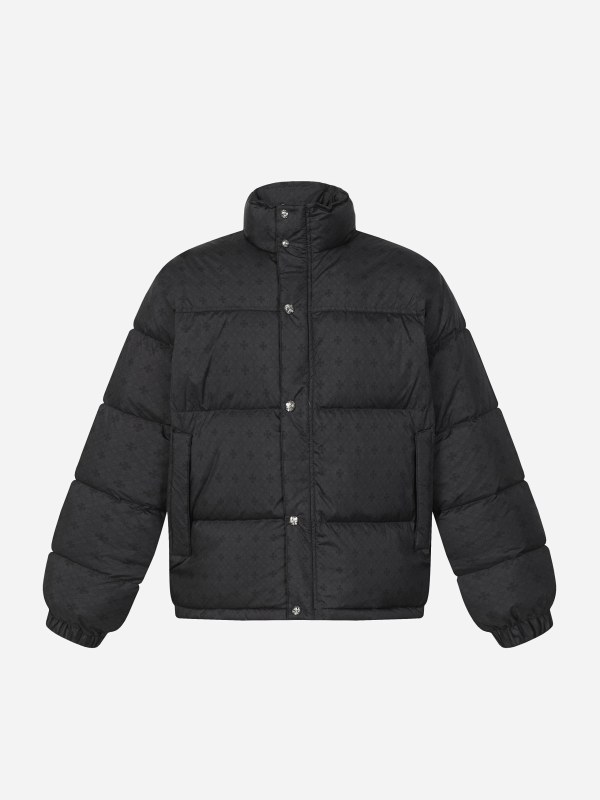
- Hands-on score
- 4.1 / 5
- Editor score
- 4.1 / 5
Editor verdict
A convincing tonal-jacquard puffer with genuinely sealed cuffs and hem, undermined by a mid-chest snap gap and an unpublished fill spec. We scored it 4.1 / 5.
What works
- Tonal jacquard weave reads as dimensional texture, not a flat print
- Elastic cuffs and adjustable hem held a full seal in crosswind
- Smooth snap hardware and even quilting stitches on our sample
Watch-outs
- Placket flutters between snaps at mid-chest in wind
- No fill power, down ratio or measurements published
- Stain-resistant and breathable claims are seller statements only
Street-style buyers in dry cold who want a tonal-jacquard layer with real winter volume and are happy to confirm specs through an agent.
Anyone who needs a graded warmth rating, a published size chart, independent buyer feedback, or a brand-authorized return path.
Puffers rarely fail at the shoulders. They fail at the closures — the line of snaps down the chest, the hem that rides up when you sit, the cuff that gapes when you reach for a train door. So when the Chrome Hearts black puffer jacket in cold-weather street style arrived at our Athens testing desk, we did not start with a mirror. We started with a cold room, a box fan, and a strip of tissue paper taped along the placket.
The jacket is listed at $149.25 USD, down from $160.65, SKU 7702084635, in stock in S, M, L and XL. It is a black down-filled puffer with a tonal jacquard motif woven into the shell, a high stand collar, front snap closures, elastic cuffs, an adjustable hem, and “smooth hardware” in the seller’s own words. No fill power, no down-to-feather ratio, and no published measurements accompany it.
How we tested the draught question
Our sample was a size L. We logged the parcel on arrival, hung the jacket for 24 hours to recover from shipping compression, then ran three sessions in our Koukaki workshop cold room set to 2 °C, with a fan pushing roughly 12–15 km/h of crosswind at chest height — the kind of wind you meet on a street corner, not a summit.
In each session we taped 12 cm strips of tissue paper at four points: the collar-to-chin gap, the placket at mid-chest, the placket at the waist, and the hem edge. Movement in a strip means air is moving through or past that point. We also pressed a strip of low-tack tape over each snap to check alignment, and photographed every snap pair before and after five open-close cycles.
What the draught map showed
| Test point | What we saw | Reading |
|---|---|---|
| Stand collar | Tissue lifted slightly at the chin notch when turning the head; settled when the zip-style storm flap was smoothed flat | Minor leak, correctable with a scarf |
| Placket, mid-chest | Steady flutter between the second and third snap | The weak point of the jacket |
| Placket, waist | Occasional flutter only under gusting | Acceptable |
| Hem with adjuster cinched | No movement | Genuinely sealed |
| Elastic cuffs | No movement, even with arms raised | Best-executed detail on the jacket |
The mid-chest flutter is a spacing issue, not a hardware defect. Snap centres on our sample sat about 9 cm apart, and the shell between them has no continuous backing strip, so the fabric bows outward under wind load. Wear a mid-layer with a high neck and the problem mostly disappears; wear the jacket over a thin tee in a real wind and you will feel a cool stripe down the sternum.
The jacquard shell, up close
This is the detail the photographs undersell. The motif is tonal — black on black — and reads as texture rather than pattern. Under raking light the weave shows a soft, dimensional shift across the chest and sleeves, and it does not have the flat, plasticky look of a printed monogram. We checked the inner face of the shell at the hem seam: the motif stops where the fabric is turned, which is what we would expect from a woven jacquard rather than a surface print.
We also sprayed the sleeve with roughly 40 ml of water over 30 seconds. It beaded and rolled off, and the fabric underneath felt dry to the touch after ten minutes. That supports the listing’s water-resistant claim at the level of light rain. It is not a laminate, and we would not treat it as a shell for sustained rain. The stain-resistant and breathable claims remain seller statements — we can confirm the water behaviour and nothing more.
Warmth, weight and what the fill does
Our sample weighed 1.06 kg on the luggage scale, and the parcel came in at 1.3 kg. The fill is described as down, evenly distributed, with no ratio given. We can report behaviour: after 30 minutes in the cold room over a cotton tee, chest skin temperature held steady, and the sleeves stayed lofted rather than flattening at the elbow crease. After compressing the jacket into a stuff sack for two hours and hanging it for 20 minutes, it recovered most of its loft, with a slight thin patch at the lower-left quilt channel that we could shake back into place.
What we cannot tell you is how it compares to a 90/10 goose-down jacket, because the seller does not publish a fill specification. Comparable Chrome Hearts puffers on the resale market are commonly listed with 90% down and 10% feather, but that is a line-level pattern, not a fact about this jacket. If fill ratio matters to you, ask before paying.
Fit and layering
Flat measurements on our size L: 22.5 in pit-to-pit, 28 in back length, 19.5 in shoulder, 26 in sleeve. That is a full, roomy cut that swallows a midweight hoodie without pulling at the snap line — and, usefully, without lifting the hem when you raise your arms. The stand collar sits high enough to cover the chin when fully fastened, which we liked, though it also means a beard or a scarf crowds it.
Sizes run S through XL with no chart, so the fit is the biggest unknown in the purchase. If you sit between sizes and plan to layer heavily, take the measurement route through your shopping agent rather than guessing.
Hardware, stitching and the small stuff
Snap rims were smooth on all twelve closures, with no burrs catching on the fabric, and five open-close cycles produced no loosening. Stitch density along the quilting channels looked even under a loupe, with no skipped stitches at the armhole or hem. The adjustable hem toggles held their position through a full day of walking and sitting.
One caution worth repeating: the only outside editorial description we could find covers Chrome Hearts puffer jackets as a category, not this specific jacket, and there is no independent buyer testing to lean on. Our numbers are one sample, measured honestly, and they should be read that way.
Where that leaves the jacket
As cold-weather street style, it works. The tonal jacquard gives it presence without shouting, the cuffs and hem do their job, and it layers over a hoodie without turning into a box. As a technical cold-weather garment, it has one weak line down the chest and a specification sheet with holes in it. Buy it for the look and the sealing details, verify the fill and the measurements first, and add a scarf.
How we tested
Cold-room sessions at 2 °C with 12–15 km/h crosswind, tissue-strip draught mapping at collar, placket and hem, snap alignment photos, flat measurements on a size L, parcel and garment weights, a 40 ml spray test, and a two-hour compression re-loft check.
Sources and notes
- Catalog product page
Product listing verified on 2026-10-22.
Is the fill real down, and how warm is it?
The listing says down, evenly distributed, but gives no fill power or down-to-feather ratio. Ours held warmth in a 2 °C cold room over a tee; treat the warmth as unrated until your agent confirms the fill specification.
Is the jacquard woven or printed?
On our sample the motif disappeared at the turned hem seam and shifted with the weave under raking light, consistent with a woven jacquard. At 40 ml of sprayed water it beaded and rolled off.
What should I confirm before ordering?
Ask for flat chest and length measurements in your size, close-ups of the placket snaps, cuffs, hem adjuster and zipper pulls, and the stated fill composition. No size chart is published.