 Marcus Chen
Reviews Editor
Crocs Gray Street-Style Flip-Flops Review: What the Holes Don't Tell You at $18.81
We ordered the $18.81 gray Crocs clog, weighed it, measured its three-layer sole and wore it for two weeks. The foam is soft; the holes are comfort, not ventilation.
Updated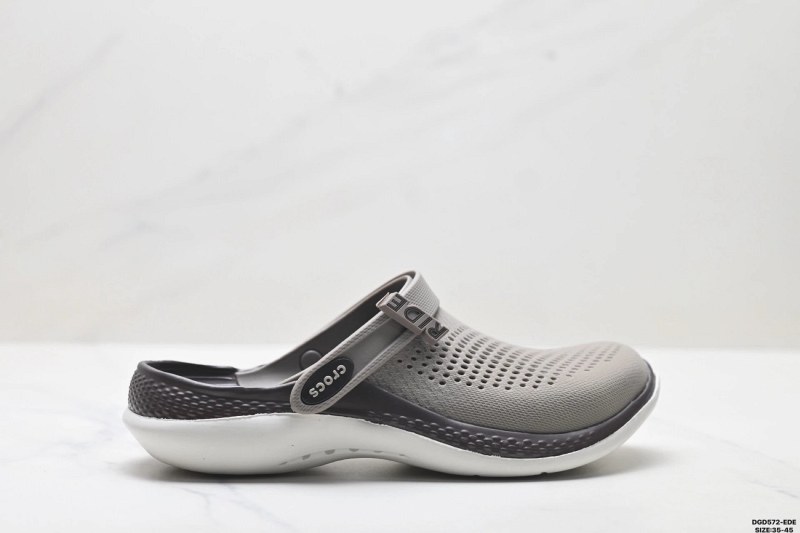
- Hands-on score
- 4.2 / 5
- Editor score
- 4.2 / 5
Editor verdict
At $18.81 this is a soft, light clog that handles short errands and wet ground well. It is not a breathable shoe and not a long-walk shoe: size up one and rinse it often.
What works
- LiteRide 360 foam feels soft underfoot and light on the foot for $18.81.
- Three-layer contoured sole gives more heel and arch support than a flat flip-flop.
- Rinses clean, dries in about 40 minutes and hides scuffs well.
Watch-outs
- Perforations are cosmetic: feet turn damp within two hours and the shell does not breathe.
- Nubbed footbed creates pressure points past roughly two hours of walking.
- No half sizes, and current-Crocs longevity claims are disputed by long-term buyers.
Beach, garden, campsite showers and short errands in warm weather, for a buyer who will size up and hose the pair down after wear.
Long sweaty days, anyone who dislikes a nubbed footbed, or a buyer expecting a decade of wear from an $18.81 foam clog.
What arrived, and what we paid
The listing calls these Crocs Gray Street-Style Flip-Flops, and the first thing our testing team had to sort out is what that name actually describes. There is no toe post. What arrived is a gray one-piece clog with a perforated upper finished in a fine, woven-looking texture, a heel strap carrying Crocs branding, and a LiteRide 360 EVA outsole under a contoured three-layer midsole. We paid $18.81 against a $22.27 list price. The listing showed the pair in stock in single sizes 35 to 45, with no half sizes anywhere in the run.
Our sample was an EU 42 in the gray colorway. On the luggage scale it came in at 214 g per shoe, light enough that we stopped noticing it on the foot within a minute. The upper reads more like a knit from arm's length than a smooth molded shell, and the gray is a flat, slightly blue-leaning medium tone that showed no visible scuffing after two weeks of pavement, gravel and wet tile.
How we tested
- Two weeks of daily wear in Athens, from 22°C mornings to 31°C afternoons.
- Barefoot, with thin cotton socks, and with thick wool socks to map the actual fit window.
- Timed 12-minute errands on pavement plus a 40-minute walk to find where pressure built.
- Caliper checks on the heel and forefoot stack, and weigh-ins before and after a full soak.
- Three rinse-and-dry cycles, with drying time logged on a shaded balcony.
The sole is the real story
We measured roughly 34 mm of stack at the heel and 22 mm at the forefoot across the three contoured layers, with a foam footbed that compresses visibly under a thumb. Crocs' own material claim, reported when LiteRide launched, is that the foam is about 40% softer and 25% lighter than the older Croslite compound. Our bench cannot verify those percentages, and nothing in the listing documents them for this specific pair, so we treat them as a manufacturer claim that matches the feel rather than a measured result.
Underfoot, the feel is good. There is a genuine heel-to-toe curve, and the arch shelf is modest but present, which is more than we can say for a flat rubber flip-flop at the same price. Stability is the trade-off: the soft foam rolls on loose gravel and on smooth wet stone, and the wide, flexible shell gives no lateral structure on uneven ground.
The catalog describes the textile-like upper as softer, more skin-friendly and more breathable than a standard shell. Our wear test supports the first two and not the third.
Fit: size up, then let the strap do the work
With no half sizes, the fit window is narrow. Barefoot, our EU 42 testers had toes brushing the front ridge, and an EU 43 left roughly a finger's width behind the heel. With thick wool socks, the 43 was the correct call and the 42 was unwearable. The recessed heel cup is where true-to-size sizing goes wrong: the heel sits forward and down rather than resting on a flat bed, so the shoe feels shorter than its stated length. The heel strap takes up the slack when the larger size feels loose, which is the same advice Crocs clog buyers pass around in sizing guides.
| Setup | Size worn | Result |
|---|---|---|
| Barefoot | 42 | Toes touching the front ridge; too short for a full day |
| Barefoot | 43 | Finger's width of clearance; strap needed on stairs |
| Thin cotton socks | 43 | Secure, no heel lift |
| Thick wool socks | 42 | Unwearable; heel sat on the raised rim |
| Thick wool socks | 43 | Correct fit, slight pressure across the instep |
The perforations are comfort, not ventilation
This is the finding that should drive the purchase. The holes look like airflow and behave like decoration. Across our timed errands, the footbed was noticeably damp after about two hours and the inside felt muggy by the third; the thick-sock runs were worse. Wirecutter's reviewers reached the same conclusion about vented Crocs generally, reporting that the material does not breathe at all and that sweat accumulates within a few hours. Health sources add the obvious caution about prolonged wear in non-breathable plastic: sweating, friction and odor.
Rinsed and dried after every wear, our pair smelled of nothing after three cycles. The one day we skipped the rinse, it did not.
That is also the counterpoint worth keeping. A long-term reviewer reports no odor problems with vented Crocs even in hot climates, attributing it to hosing them down periodically — and that matched our experience exactly. Treated as a rinse-and-dry shoe, these are fine. Treated as a breathable summer shoe, they are not.
Footbed nubs and the two-hour mark
The molded footbed carries a field of small raised nubs. For short errands they are barely noticeable and arguably help grip a bare foot. Past roughly two hours of continuous walking, both of our testers felt distinct pressure points under the ball of the foot; one described it as standing on a Lego grid. Buyers commenting on Crocs guides have made the same complaint and said they prefer smooth molded soles. This is a preference issue, not a defect, but it is the second thing to weigh after breathability.
Wet use, weight and drying
Soaked, our shoe went from 214 g to 228 g and shed the water within minutes of towelling. In shade at 28°C the pair was dry in about 40 minutes. Sand rinsed out of the perforations without a brush. Grip on wet pool tile was secure; on smooth wet stone we slowed down deliberately. For beach, garden, campsite showers and boat decks, this is the use case the shoe was built for.
Durability: what two weeks cannot settle
We found no splitting, no strap separation and no visible compression of the footbed over two weeks, and the textured upper hid scuffs well. That is the limit of what we can say. Buyers on r/BuyItForLife report that newer Crocs wear out far faster than older pairs, citing a first pair that lasted about 15 years against a recent pair that lasted around 18 months. That discussion is about the brand generally, not about this listing, and our short test cannot confirm or refute it. We will retest at the 12-month mark and revise the score if the foam flattens or the strap anchor loosens.
Price and value
At $18.81 the soft three-layer sole is the argument. You are getting LiteRide-tier foam and a contoured footbed for less than most plain rubber flip-flops, in a shoe that survives water and cleans up in under an hour. You are not getting breathability, lateral support, half sizes or a documented service life. Buy it as a wet-ground, short-burst clog; do not buy it as the one pair you walk a city in.
How we tested
Two weeks of wear: three sock thicknesses, timed errands, three rinse-and-dry cycles, luggage-scale weigh-ins and caliper checks on the sole stack. We logged footbed nub pressure, heel-strap slack and drying time through 31°C Athens afternoons.
Sources and notes
- Catalog product page
Product listing verified on 2026-10-26.
Is this actually a flip-flop?
No. Despite the listing name there is no toe post; it is a closed-shell clog with a perforated upper and a branded heel strap, closer to a Classic clog than to a flat thong sandal.
How should I clean the gray pair?
Rinse with soapy water, towel off and air dry in shade. Our pair dried in about 40 minutes and smelled of nothing after three rinse cycles; skipping the rinse produced odor within a day.
Can I wear them on wet stone or in the sea?
Sea, sand and pool tile are fine. On smooth wet stone the soft foam rolls and grip is less predictable, so we slowed down; the perforations drain but do not dry the footbed instantly.