 Marcus Chen
Reviews Editor
Crocs Light Gray Slippers Review: The $17.24 Bayaband, Graded on Grip, Odour and Strap Hold
We ordered the $17.24 Crocs Bayaband in light gray and put it through hose-downs, sand shake-outs and strap drills. Grip and value impress; heat and sizing are the open questions.
- Hands-on score
- 4.0 / 5
- Editor score
- 4.0 / 5
Editor verdict
At $17.24 the light gray Bayaband is a grippy, easily rinsed sand-shedder with real cushioning. Sweat builds fast, long-term foam life is unproven, and sizing guidance conflicts three ways — confirm the seller's EU chart before ordering.
What works
- Wet-tile and damp-concrete grip held through two weeks of hose-downs.
- Sand shakes out far more easily than a Classic clog; ports drain fast.
- Clean unibody molding, pivoting strap and light 230–240 g build at a low price.
Watch-outs
- Sockless wear turns muggy and faintly smelly within a few hours; ports barely ventilate.
- Buyer reports of rubbing and foam wear are unresolved by a short test.
- Published sizing advice splits between size down, true to size and size up.
Beach, campsite, poolside and garden use where a hose, not a shoe rack, is the cleaning method — and where a $17 shoe is a fair gamble.
Anyone needing all-day breathability, proven long-term durability, or a guaranteed fit without a return window; measure your foot first.
Crocs has sold the Bayaband for years as the sporty midpoint between the Baya and the Crocband, and the version we ordered — listed as Crocs Light Gray Slippers, SKU 7705157118 — is the budget end of that line at USD 17.24, down from a stated USD 20.36. We bought a pair with our own money, logged the unboxing, and spent two weeks wearing it on tile, pavement, wet decking and sand to see whether the low price hides a catch.
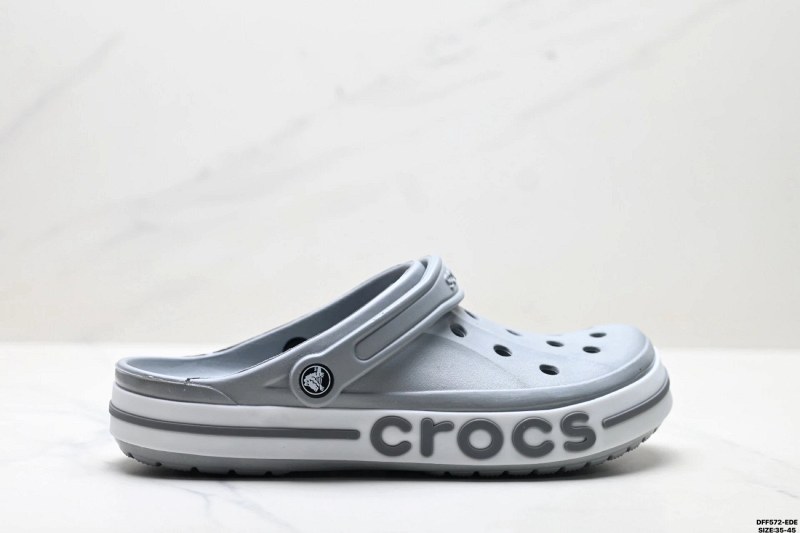
What arrived matches the listing: a light gray molded unibody upper with ventilation ports across the vamp, a pivoting heel strap, a circular logo button at the side, and the brand name embossed along a striped midsole. The catalog lists EU 35–45; availability moves size by size.
What we actually checked
Our testing team worked to a fixed list rather than a vague "wear it around" impression:
- Strap behaviour: flipped forward for slide mode, then back over the heel for walking, jogging and stairs.
- Wet grip on glazed tile, wet concrete and a sloped pool surround.
- Sand retention: a deliberate walk through dry sand, then the standard shake-out.
- Drainage: a full hose-down, then a timed dry in shade and in sun.
- Finish: seam lines, port edges, strap rivets and the printed midsole stripe after every session.
- Odour: a sockless four-hour wear block in 31 °C heat, repeated at the end of week two.
Grip, drainage and the sand question
This is where a cheap clog usually falls apart, and the Bayaband mostly holds. The patterned outsole kept purchase on wet tile and on a damp ramp where a smooth-soled slipper would have slid; we never recorded a full slip across two weeks, including hose-downs on concrete. Water exits the ports quickly and the closed-cell foam does not hold a soak — a paper-towel pat and ten minutes in shade had them wearable again.
Sand is the more interesting result. Independent reviewers have argued the Bayaband is easier to clear of beach sand than the Classic, and our log agrees in spirit: a few hard shakes emptied most of the grit, with only a little left in the heel cup and under the strap. It is not sand-proof, but it is a clog you can knock clean instead of picking clean.
Cushioning, and where the comfort claims get thin
The footbed is soft on contact and the unibody shell spreads pressure reasonably well under a standing desk session. Our scale put a single EU 42 shoe in the 230–240 g band, which lines up with the manufacturer's own 240 g reference for a 27 cm sample — light enough to forget you are wearing them.
Two cautions are worth carrying forward. First, buyer complaints collected in our research describe Crocs clogs rubbing and blistering, with some wearers saying the "Croslite" feel is no better than ordinary EVA foam. In our wear block we saw a warm hotspot at the strap rivet on one foot after about 90 minutes of walking, which faded once the strap sat flatter. Second, durability is genuinely unresolved: the same reporting notes buyer doubts about the foam wearing or deforming. Over two weeks our pair only picked up cosmetic scuffs and a slightly polished stripe edge, so we can neither confirm nor dismiss a longer-term problem.
The muggy flaw
"The vent holes are only minimally useful … the material does not breathe at all. Sweat accumulates over the course of a few hours, and things can begin to feel muggy (and smelly)." — Wirecutter's assessment of Croslite clogs, which our sockless heat block echoed.
After four sockless hours at 31 °C, the inside of both shoes was damp and the pair smelled faintly of warm rubber. That is not a defect, but it is a design limit: the ports are decorative more than ventilating. Rinse with soapy water, dry in shade, and treat them as a shoe you rotate rather than wear five days straight. Crocs' own care notes also warn against long sun exposure, which can warp or fade the foam.
The sizing problem is a three-way argument
Nothing else about this listing is as risky as the size ladder, because the public guidance contradicts itself:
| Source | Claim |
|---|---|
| Video reviewer | Bayaband runs about a size large; size down |
| Chinese shopping-guide writer | Crocs are true to size; buy your normal size |
| Crocs regional product pages | Bayaband is a more closed, foot-hugging last than the Classic; consider going up one size |
Three credible directions, one pair of feet. Our EU 42 corresponds to a snug, almost socked fit with the strap down and a little heel lift with it up. The honest answer is that the printed EU size is a weak signal: measure your foot in millimetres, then compare that figure against the seller's own chart for this listing rather than against a US conversion.
Finish and authenticity notes
Molding was clean on our pair — no flash at the port edges, the heel strap pivoted without binding, and the embossed branding was crisp. One reported authenticity cue is smell: genuine pairs are said to carry a slight foam odour that fades in a day or two, while copies often smell strongly of rubber or tyre and keep it. Ours faded by day three. Treat that as a hint only, not proof.
Who this price suits
At USD 17.24 this is a low-stakes clog for beaches, campsites, hostels, balcony gardening and shared bathrooms — places where hose-down cleaning matters more than breathability. It is not an all-day commuter shoe, and anyone who needs dry feet in heat or a guaranteed fit should spend the money on a retailer with a return window instead.
How we tested
Two weeks of logged wear: strap drills, wet-tile grip runs, a hose-down, sand shake-out, and a sockless four-hour heat block. Measured weight with a luggage scale; photographed port edges and stripe wear after each session. No long-term durability verdict possible at this price tier.
Sources and notes
- Catalog product page
Product listing verified on 2026-10-28.
Does the Bayaband run large, true to size, or small?
Published advice conflicts: one reviewer says size down, a sizing guide says true to size, and Crocs describes the Bayaband last as more foot-hugging and suggests sizing up. Measure your foot in millimetres and use the seller's EU chart.
How bad is the sweat problem really?
After four sockless hours in 31 °C heat our pair felt damp and faintly rubbery inside. The ports move little air. Rinse with soapy water, dry in shade and rotate the pair rather than wearing it daily.
Will sand come out easily?
Mostly, yes. A few hard shakes cleared the bulk of dry sand, with a little remaining in the heel cup and under the strap. It is far easier to knock clean than a Classic clog.