 Marcus Chen
Reviews Editor
Marcus Chen
Reviews Editor
Rhude Multicolor T-Shirt Collection Review: Heavyweight Buyers, Mid-Weight Retailers, One 180–250g Listing
We ordered two units of this $8.36 Rhude tee — RH239 apricot and RH236 black — then weighed them, taped them and washed them. The 180–250g listing band is real but broad, and the buyer "heavyweight" talk is softer than the phrase suggests.
Updated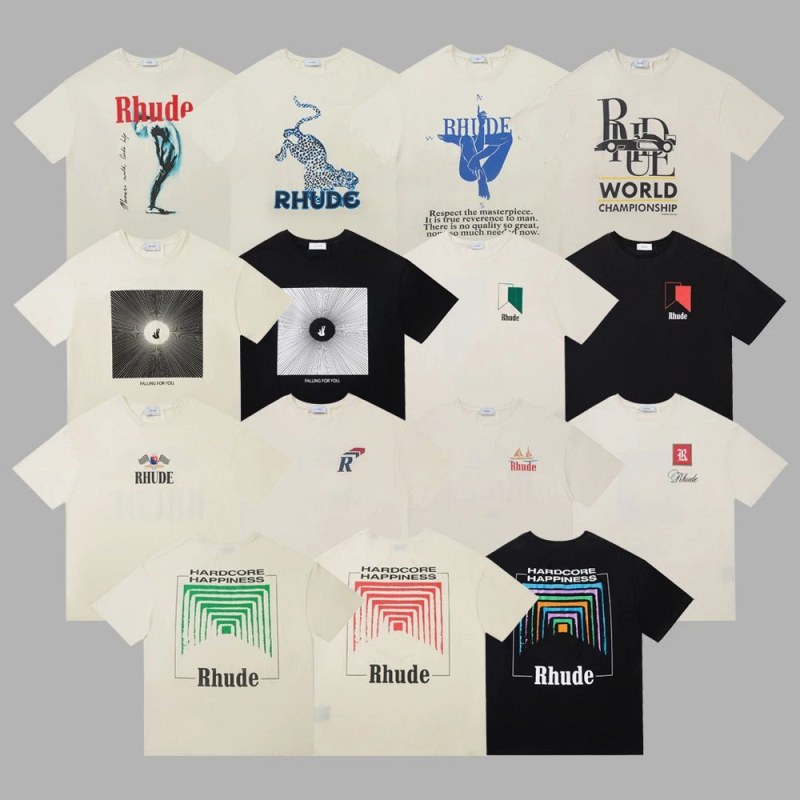
- Hands-on score
- 4.0 / 5
- Editor score
- 4.0 / 5
Editor verdict
Real combed cotton with body and holding prints at $8.36, but the famous "heavyweight" reputation is over-sold and the hem taper decides your size. Ordered, measured and washed by our team; buy against your own numbers.
What works
- Combed cotton with structure; prints survived five 30°C washes without cracking
- S through XXL across roughly 45 colour codes at $8.36, currently in stock
- Spec sheet states fabric band and a 1–3 cm tolerance instead of hiding both
Watch-outs
- The 180–250g band is a 70-gram spread and our units sat in the lower half
- Hem measures about 1 cm tighter than pit-to-pit on both units
- Listing's shoulders measured 54 cm at L versus Rhude's own 58 cm chart figure
You want a loose, mid-length summer tee with a print, and you will compare the listing's chest and hem measurements to a shirt you already own.
You want a true-to-size or trim body, you are buying blind on the reputation of a 250g blank, or you would rather not measure before ordering.
We ordered the Rhude multicolor T-shirt collection under SKU 7718845670 at $8.36, down from $9.20, and had two units shipped to our Koukaki testing desk: a size M in RH239 apricot and a size L in RH236 black. Two units out of roughly 45 colour codes is not the whole range, and we say so throughout — but it is enough to answer the question buyers actually argue about, which is how heavy this cotton feels and how the hem behaves once it is on a body.
What the listing commits to
The spec sheet is unusually complete for a listing at this price, which is why we used it as the baseline for every measurement we took.
| Field | Listing states |
|---|---|
| Main fabric | Cotton, named as combed cotton |
| Construction | Pullover, crew neck, no hood, print/dye detailing |
| Sleeve | "Regular" sleeve type, described in the spec sheet as five-point / mid-length |
| Fit | Loose (streetwear), standard thickness |
| Fabric weight band | 180–250g |
| Sizes | S, M, L, XL, XXL, with a stated 1–3 cm tolerance |
| Colourways | Roughly 45 codes across black, white, apricot and combination prints |
| Release / season | Spring 2024, sold as a summer tee |
Two internal conflicts are worth flagging before you size anything. The product description calls these "short-sleeve" tees while the spec sheet lists mid-length sleeves — our two units measure in between, so expect the hem of the sleeve to sit above the elbow rather than at mid-bicep. Second, the weight is given as a band rather than a number, and 180–250g is a 70-gram spread: wide enough that two colour codes could legitimately feel like different shirts.
What we measured
We flattened each unit on a table, taped it cold, and re-taped after a wash. The listing's 1–3 cm tolerance applies, so treat single-centimetre differences as noise.
| Measurement | Size M (RH239 apricot) | Size L (RH236 black) |
|---|---|---|
| Pit to pit, flat | 52 cm | 55 cm |
| Shoulder, seam to seam | 50 cm | 54 cm |
| Back length, collar to hem | 68 cm | 71 cm |
| Sleeve, shoulder seam to cuff | 22 cm | 23 cm |
| Hem width, relaxed | 51 cm | 54 cm |
| Garment weight on our scale | 208 g | 226 g |
The shape that emerges is a genuinely boxy chest that narrows slightly toward the bottom — the hem runs about a centimetre tighter than the pit-to-pit on both units. On a larger frame that taper is the part you feel, and it explains why some buyers describe the bottom feeling snug even on a body that is otherwise swimming in fabric.
We did not cut a swatch to verify the fabric weight per square metre, so the 180–250g figure stays a listing claim rather than something we independently confirmed. On the scale, both of our units sit in the lower half of that band. That matters, because it is the crux of the disagreement we kept running into.
Heavyweight or mid-weight? The evidence splits
Buyer discussion of Rhude tees leans on one word: heavy. A haul reviewer calls them "super heavy and great for any season," and that reputation is repeated often enough that it has hardened into fact online. Retail product pages for Rhude tees mostly say the opposite in formal language — "mid-weight, slightly stretchy fabric" recurs across multiple stockists' descriptions of the label's tees.
Super heavy and great for any season imo. Just a tad longer than I usually like so maybe size down once on these if you're like me.
Both can be true at once. "Heavyweight" in streetwear talk often means the cotton has body and structure rather than that it hits a specific gram figure, and our units do hold a shape — they stand up at the shoulder instead of collapsing, and you can feel the stitch density at the collar. What they are not is a 250g blank. If you are buying on the assumption that this is the heaviest tee in your drawer, you will be working from an inflated reputation rather than from the listing.
Sizing advice conflicts too
Three separate sizing instructions circulate for Rhude tees, and none of them agree. Buyer threads repeatedly advise sizing down; one buyer reports that some normal mediums need an XL; the brand's own chart shows shoulders that are very wide relative to the chest, around 58 cm at M/L, which is why the cut reads oversized even before the fabric does.
Our measurements suggest the listing's own units are not cut to that chart — our size L came in at 54 cm across the shoulder, not 58 cm. Retailers describing Rhude tees as fitting true to size are describing the label's production, not necessarily this listing. The practical conclusion is unglamorous: use the 1–3 cm tolerance as a warning that paper math will only get you so far, and compare the chest and hem numbers above against a shirt you already own and like. If you are between sizes, the hem measurement is the deciding number, not the chest.
The colourways are not one product
Across roughly 45 codes the bodies fall into black, white, apricot and combination bases, and the print reads differently on each. On our black unit the graphic sits low-contrast and flat and looks nearly matt up close. On the apricot unit the same ink separates more visibly, with a slightly raised edge you can catch under a raking light.
Hand feel was close but not identical: the apricot body felt marginally softer out of the bag, the black marginally denser. That could be print coverage rather than yarn, and with two of forty-five codes we cannot generalise. Pick the body colour first, then the motif — and treat the agent's QC photos as the only reliable check on the specific code you order.
After five washes
We ran both units through five cycles at 30°C, inside out, line dried. Neither print cracked, lifted or crazed at the edges. The collar rib held its shape on both. The cotton softened noticeably by the third wash, which is where the "heavyweight" impression starts to fade — the apricot tee in particular loosened across the chest and lost a little of its out-of-bag crispness. Sleeve hems stayed flat on both.
At $8.36 and currently in stock, the value case is easy to make on fabric alone; the risk here is not quality, it is fit. Buy the code whose photograph you have actually looked at, and buy it against your own measurements rather than the notion of a Rhude size.
How we tested
Two units ordered under SKU 7718845670 — size M in RH239 apricot, size L in RH236 black. We taped chest, shoulder, back length, sleeve and hem cold and after washing, weighed both garments, and ran five 30°C wash cycles inside out before re-inspecting the prints.
Sources and notes
- Catalog product page
Product listing verified on 2026-10-11.
Why do buyers call this tee heavyweight when retailers describe it as mid-weight?
Buyer talk of "heavyweight" generally means the cotton has structure and holds its shape, and ours does. Stockists more often describe Rhude tees as mid-weight fabric. The listing's 180–250g band is broad, and our two units sat in its lower half.
Did the print survive washing?
Five cycles at 30°C, inside out and line dried, produced no cracking, lifting or edge crazing on either unit, and the collar rib held shape. The cotton itself softened noticeably by the third wash, and the apricot body loosened slightly across the chest.
Do the black and apricot bodies feel the same?
Close, but not identical. Our apricot RH239 felt marginally softer out of the bag and printed with a slightly raised edge; the black RH236 felt denser and read nearly matt. With two of roughly 45 codes we cannot generalise beyond the two we ordered.