 Elena Papadakis
Editor-in-Chief
Elena Papadakis
Editor-in-Chief
Polo Ralph Lauren Accessory Picks: Spreadsheet vs. Sheets
## Clarify the Purchase Task for Organizing Polo Ralph Lauren Accessory Candidates If your goal is to find Polo Ralph Lauren related accessory candidates from [fashionreps](https://fashion-reps.net/)' product catalog and organize them into a checklist for later review, comparison, and additional verification, the key is not simply jotting down a few product names, but establishing a clear information chain: brand entry, product category, color or specification, product image, original page, and
Updated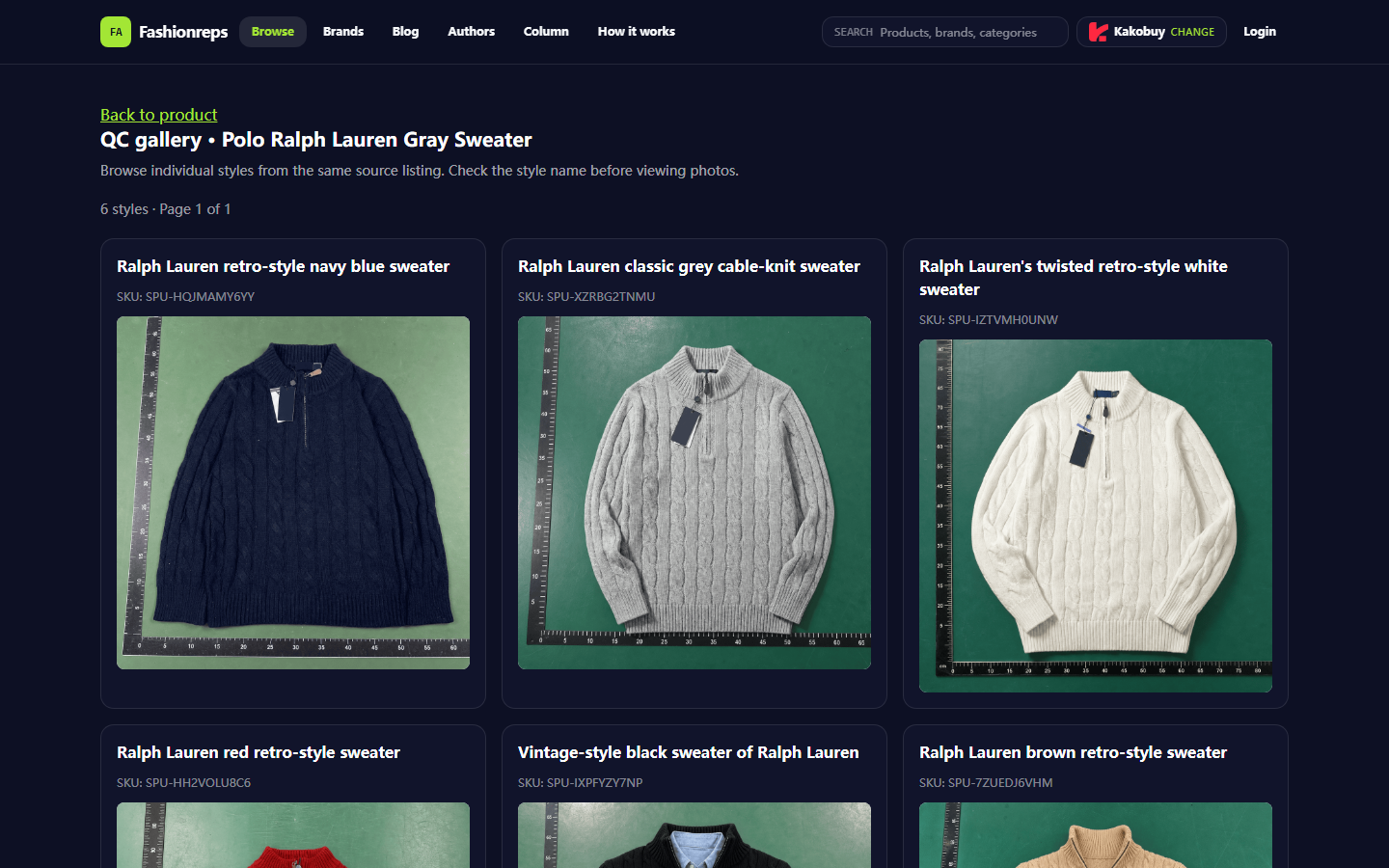
Clarify the Purchase Task for Organizing Polo Ralph Lauren Accessory Candidates
If your goal is to find Polo Ralph Lauren related accessory candidates from fashionreps' product catalog and organize them into a checklist for later review, comparison, and additional verification, the key is not simply jotting down a few product names, but establishing a clear information chain: brand entry, product category, color or specification, product image, original page, and current visible status. 🧭
This organization suits the following tasks:
- Discover Polo Ralph Lauren hats, scarves, belts, bags, or other accessory candidates from the brand catalog.
- Consolidate information scattered across product cards and detail pages into one sheet.
- Narrow down candidates by category, color, specification, or link status.
- Keep traceable records for later QC image viewing, product info confirmation, and purchase platform selection.
This organization is not suitable for directly proving that products are in stock, quality-assured, authentically sourced, or currently purchasable. fashionreps' catalog and pages serve only as an entry point for discovery and organization; orders, payments, and shipping are still handled by the user's chosen external shopping agent website.

Figure: Brand and QC browsing entry for Polo Ralph Lauren related pages on fashionreps.
Verify Brand Entry, Product Cards, and Currently Visible Links from fashionreps Website Spreadsheet
When starting to organize, first enter Polo Ralph Lauren from fashionreps' brand browsing entry, rather than directly copying search results into the table. This helps confirm whether pages are indeed organized by brand, and then check if each product card contains enough visible information.
Check in the following order:
- Enter the brand or catalog entry, and confirm the correspondence between page title, brand name, and product list.
- View the product card's name, category, image, and clickable entry.
- Open the candidate product detail page to verify it is still accessible and displays a clear product name.
- If the page provides a QC entry, check whether the QC page corresponds to the same product or same sourced style.
- Record the currently visible links and information; do not fill in inventory, price, material, or size that the page does not display.
Among visible Polo Ralph Lauren pages, QC pages show a list of sourced styles; for example, relevant pages display multiple sweater styles and corresponding SKUs. Such pages help you distinguish different styles under the same source, but you cannot infer accessory inventory from style names alone, nor treat QC images as proof of purchase or receipt.
When organizing, product links can be divided into three categories:
- Verifiable: page opens, has a clear product name, and enough fields to support later comparison.
- Needs follow-up: page accessible, but category, specification, or source information is incomplete.
- Hold: link redirects abnormally, page is empty, only tag information, or cannot be confirmed to correspond to a specific product.
This classification is more reliable than simply marking "buyable," because page visibility does not equal inventory availability, and product card existence does not mean the external agent can still place orders normally. 🔎
Use Google Sheets to Create Fields for Brand, Category, Color, Specification, and Link
After initial screening on the website, transfer candidate records into Google Sheets. Google Sheets' role is not to replace fashionreps' catalog, but to turn discovery results into a worksheet that can be filtered, sorted, supplemented, and collaborated on.
At minimum, set up the following fields:
| Field | Record Content | Purpose |
|---|---|---|
| Brand | Polo Ralph Lauren | Maintain consistent brand filtering |
| Product Name | Original name displayed on page | Facilitate cross-checking with original page |
| Product Category | Hats, scarves, belts, bags, etc. | Filter by accessory type |
| Color | Color explicitly stated on page | Compare similar candidates |
| Specification | Size, dimensions, or other specs shown on page | Avoid guessing from images |
| Product Image | Page image or image status description | Review appearance clues |
| Product Link | Currently visible product page URL | Preserve access entry |
| QC Link | Fill in if provided on page | View QC info later |
| Page Update Time | Record viewing date or date shown on page | Assess information timeliness |
| Link Status | Verifiable, needs follow-up, hold | Manage next actions |
| Verification Notes | Missing fields, style discrepancies, or concerns | Prevent repeated checks |
Category fields should be based on actual page content. If the page only shows "accessory" or a vague category name, do not arbitrarily change it to hats, belts, or bags based on image appearance. Record it as "accessory to confirm" first, then supplement after opening the detail page.
To reduce duplicate candidates, keep the original product name in one column, and add a separate "organized name" or "filter tag" column. Original name is used for page cross-referencing, and organized tags unify color, category, and specification wording. This preserves evidence while facilitating later filtering. 📋
Comparison of Operational Steps for Website Brand Browsing vs. Sheet Filtering
fashionreps' website spreadsheet is better for discovering and reviewing products, while Google Sheets is better for organizing and collaborating. The division of labor can be arranged as follows:
| Task | fashionreps Website Spreadsheet | Google Sheets |
|---|---|---|
| Find brand entry | Browse brand catalog and product cards | Record brand filtering results |
| Determine page accessibility | Open product and QC pages | Record link status and verification date |
| View images | Directly view product or QC images on page | Save image status, description, or access entry |
| Filter by category | Rely on site's existing catalog and search entry | Use filters, sorting, and tags |
| Compare multiple candidates | Open pages one by one for comparison | Compare fields in same or adjacent rows |
| Multi-person collaboration | Primarily for shared page viewing | Use comments, assignee, and status columns for division of labor |
| Follow up on missing info | Return to product detail page for additional checks | Use notes column to record tasks |
A more practical workflow is to first discover candidates on the website, then filter in the sheet, and finally return to the original page for item-by-item review. Do not first generate product conclusions in bulk in the sheet based on keywords, because the same brand term may correspond to different categories, sourced styles, or page statuses.
If collaboration is needed, add three columns: "Assignee," "Last Verified By," and "Next Action." For example:
- Assignee: person responsible for following up on page fields.
- Last Verified By: records who most recently opened the page.
- Next Action: view QC, confirm category, supplement specification, or hold.
This reduces the likelihood of multiple people repeatedly opening the same link and recording the same candidate. 👥
How to Record Product Images, Specification Text, and Page Update Time Separately
Product images, specification text, and page update time are three different types of information and should not be mixed into one "product info" cell.
Product images mainly help identify appearance clues shown on the page. When recording, note "has main image," "has QC images," "insufficient images," or "image and name need review," but do not write image observations as experiences of having touched, tried on, worn, or received the item.
Specification text should retain the page's original wording as much as possible. If the page does not provide size, material, color, or fit information, write "not shown on page," and do not guess based on image proportions, common styles, or brand impression. For multiple styles under the same source page, create separate records for each style to avoid incorrectly merging a group of styles into one product.
Page update time needs to include the recording date. If the page itself does not show an update time, record "page update time not shown, verified on October 12, 2026." This only indicates that you viewed the page on that date; it does not mean the product information has remained unchanged since then.
Use the following notes format:
- Page verification date: October 12, 2026.
- Page status: accessible or needs follow-up.
- Page display: product name, category, and visible images.
- Not displayed: inventory, price, material, specification, or purchase restrictions.
- Next action: revisit detail page, check QC, or await update.
Such records help you distinguish between "what the page showed at the time" and "whether it is still valid later," especially for products whose price, inventory, link status, and external agent processes may change. ⏱️
Which Scenarios Are Suitable for Mobile Quick Discovery vs. Desktop In-Depth Organization?
Mobile is more suitable for quick discovery. You can browse brand entries, open product cards, save candidate links, and initially judge whether pages are related to target accessories. Mobile operation is good for building a small candidate pool, but not for lengthy comparisons of multiple fields, nor for maintaining complex filter conditions on a narrow screen.
Desktop is more suitable for in-depth organization. A larger screen makes it easier to view product pages and Google Sheets simultaneously, and to check long links, add notes, filter categories, freeze fields, and compare multiple candidates. For multi-person collaboration, desktop is also better for handling comments, assignees, and status updates.
You can adopt a mobile discovery, desktop organization division of labor:
- Discover relevant brand entries and candidate pages on mobile.
- Only save candidates that the page can clearly identify.
- Unify product name, category, color, and specification fields on desktop.
- Return to fashionreps page to verify each link.
- Add follow-up tasks for candidates with missing information, rather than deleting them outright.
If the number of candidates is very small, a mobile sheet can handle basic records; if you need to compare multiple categories, handle duplicate styles, or collaborate with others, a desktop sheet is easier to keep structured.
Boundaries: Neither Website Catalog nor Google Sheets Can Prove Inventory, Quality, or Authenticity
The website catalog solves discovery, and Google Sheets solves organization, but neither alone can prove the following:
- Product currently has inventory.
- External shopping agent definitely accepts the product link.
- Product quality meets your expectations.
- Images exactly match the final shipped product.
- Product brand authenticity has been independently proven.
- Price, shipping, taxes, or after-sales conditions won't change.
- QC images can cover all details or hidden issues.
Therefore, after completing the candidate sheet, further verification is still needed. For products you intend to purchase, check current page information, external agent availability, destination country fees and restrictions, and after receiving QC information, decide whether to proceed based on actual images and specifications. Do not handle customs issues through undervaluing, splitting orders to evade taxes, or circumventing inspections; declare truthfully according to destination country rules and confirm possible taxes or restrictions.
For account and order information, do not put complete order numbers, passports, payment cards, addresses, or full shipping labels into a public collaborative sheet. Necessary screenshots should first mask personal information, keeping only page areas that support the current judgment.
Final Action: After Completing Candidate Sheet, Keep, Follow Up, or Hold Links
After finishing organization, you can place each candidate into one of three action states:
- Keep: page accessible, product name clear, category and at least one key specification verifiable, link can serve as an entry for later review.
- Follow up: page accessible, but missing category, specification, QC info, or update time; need to return to original page for further confirmation.
- Hold: link invalid, page empty, product identity unclear, or current information insufficient to support next decision.
The time saved by this method should not be written as a fixed amount. It mainly saves time from repeated searches, repeated page openings, and multiple people organizing the same items; if irrelevant candidates are filtered out via the sheet, subsequent verification workload may also be reduced. At the same time, sheet maintenance adds recording and review costs, and page changes may invalidate old links or fields.
It is more suitable for people who need to compare multiple Polo Ralph Lauren accessory candidates, want to keep verification records, or need to collaborate with others. It is not suitable for those who want to order immediately based solely on brand name, or who treat the catalog and sheet as guarantees of inventory, quality, and authenticity.
The safest next step is to first keep a small number of candidates with complete information, then return to the fashionreps original page item by item to verify current visible content; links with insufficient information go to the follow-up column, and abnormal or unconfirmable links are put on hold.
Agent Platform Shopping FAQ
1. What product types can be browsed on kako-sheet.org?
In the kako-sheet.org spreadsheet, product range includes shoes, clothing, bags, accessories, sweatshirts, perfumes, hats, scarves, belts, and various household items.
2. How do I find the product I want to buy on kako-sheet.org?
You can search using a single keyword, or directly enter category pages, where products are also organized by brand. Longer search terms usually return fewer but more precise results than shorter terms. For example, you can search "Air Force 1 White," "sneakers," or just "Air Force 1."