 Elena Papadakis
Editor-in-Chief
Dark Over-Ear Headphones: Exterior & Structure Details
First, Determine the Main Color Relationships in the Frame This flat-lay image centers on dark over-ear headphones against a background of black, dark gray, and brown, with light beige fabric in the lower-left corner creating a warm-cool contrast. The earcups have a dark metallic finish that shifts to a blue-gray sheen under light; the headband's outer side is nearly black, the inner suspended headband is light gray, and the telescoping connectors have silver accents. 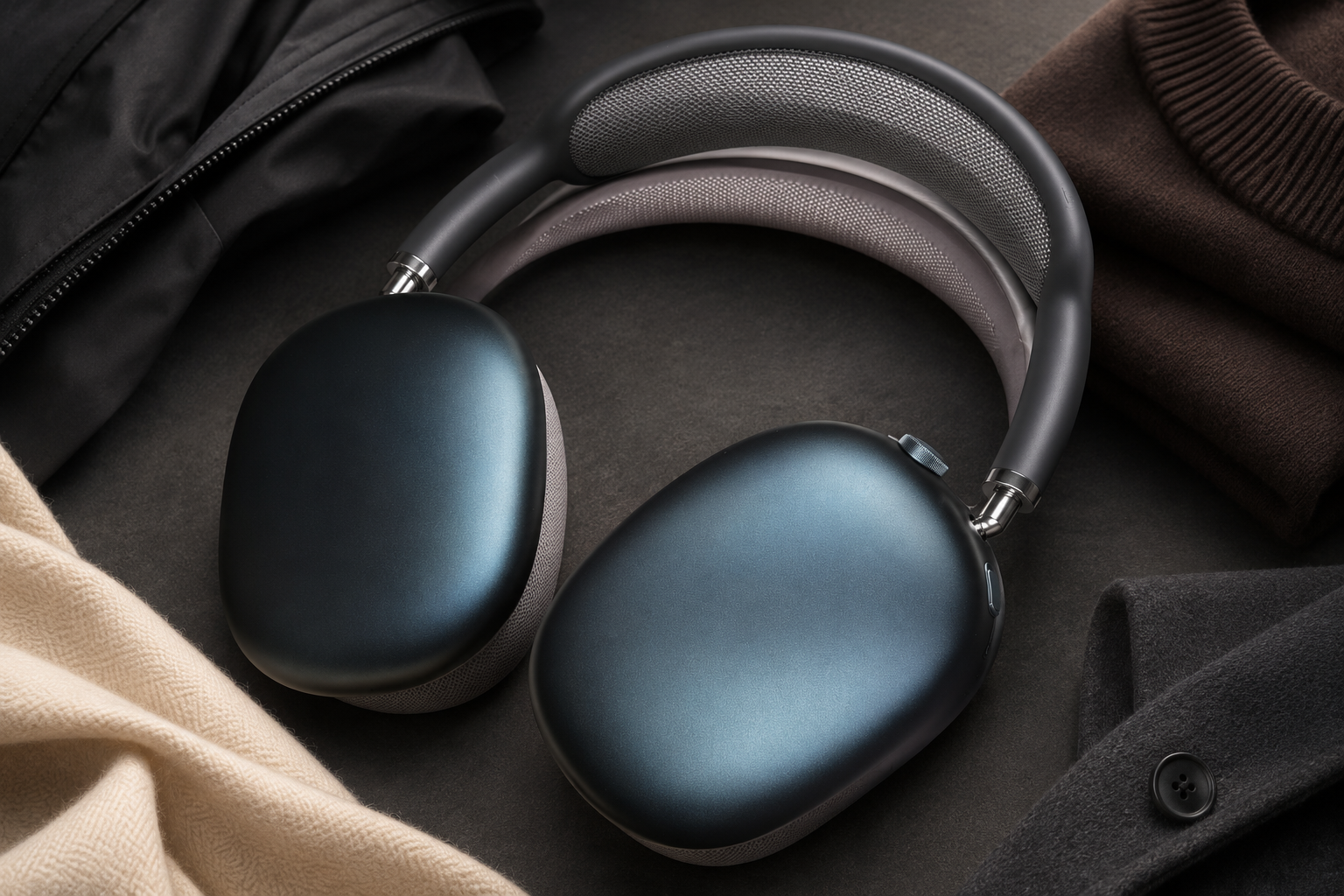
First, Determine the Main Color Relationships in the Frame
This flat-lay image centers on dark over-ear headphones against a background of black, dark gray, and brown, with light beige fabric in the lower-left corner creating a warm-cool contrast. The earcups have a dark metallic finish that shifts to a blue-gray sheen under light; the headband's outer side is nearly black, the inner suspended headband is light gray, and the telescoping connectors have silver accents.

To replicate a similar color scheme, use a combination of "dark main body, gray transitions, and light accents":
- Deep black or charcoal gray as the background helps accentuate the earcups' rounded contours.
- Medium gray serves as a transition between the headband and earcups, preventing the frame from becoming a single black mass.
- Silver small parts should be kept in the frame as structural details and brightness variations.
- Off-white or cream fabric should be placed at the edges only, not covering large areas of the subject, so as not to weaken the headphones' visual focus.
Arrange the Display with Layering in Mind
When setting up the display, fully extend the headphones so that both earcups, the headband, and the side connectors are visible. Keeping a moderate gap between the earcups shows more clearly whether the left and right shapes are symmetrical and allows the headband to form a natural arc. In this image, the headband is at the top with the earcups extending downward, giving a complete overall silhouette suitable for showcasing the exterior structure.
The background fabric can be arranged in irregular folds rather than completely smooth. Placing black or dark gray garments at the edges helps continue the overall tone; brown knit fabric adds warm layering; light beige cloth works best in a lower position to provide brightness contrast against the dark headphones. Different fabric textures can enrich the background, but patterns and decorations should be kept minimal to avoid competing with the metallic finish of the earcups.
Three Directions for Clothing Pairings
The first option is a black jacket with a dark gray knit sweater. The two dark tones can create a unified urban commuter style with the headphones; it's best to create subtle variations through zippers, buttons, or fabric texture so the headphone silhouette remains clearly discernible.
The second option is a brown knit sweater with a charcoal gray jacket. Brown adds warmth to the cool-toned dark headphones, while charcoal gray connects the headphones to the background. This pairing suits autumn/winter themed displays and offers more depth than an all-black combination.
The third option is dark clothing with an off-white scarf or sweater. Light-colored items can be placed in a corner of the frame as a visual balance point. To keep it simple, light-colored garments should be solid colors or low-texture fabrics, with the headphones still centered in the frame.
Key Considerations for Shooting and Positioning
If the focus is on showcasing the earcups' appearance, position both earcups facing upward as much as possible and preserve the rounded edges. If the focus is on structure, ensure that the headband's inner and outer layers, the silver telescoping connectors, and the joints with the earcups are all in the frame. Light can come from the upper side to create soft light and shadow variations on the earcup surfaces, but avoid harsh reflections that obscure details.
This image is suitable for assessing the overall color scheme, outer silhouette, headband layering, and visible connecting parts. Comfort, noise cancellation, sound quality, battery life, functionality, or material composition cannot be confirmed from the image alone; for pre-purchase decisions, also refer to product specifications, size information, and materials that show operational parts and wearing conditions.