 Elena Papadakis
Editor-in-Chief
Documenting Moncler Knit Top Packaging and Shipping Weight
Before submitting an overseas shipping quote for this type of parcel, the most important thing is not to first compare which route is cheaper, but to first record the product, packaging, and chargeable weight as a verifiable evidence trail. This article addresses only one scenario: when preparing to hand over a Moncler fall/winter knit top to a shopping agent or logistics tool to check overseas costs, how to determine whether the information is complete,
Updated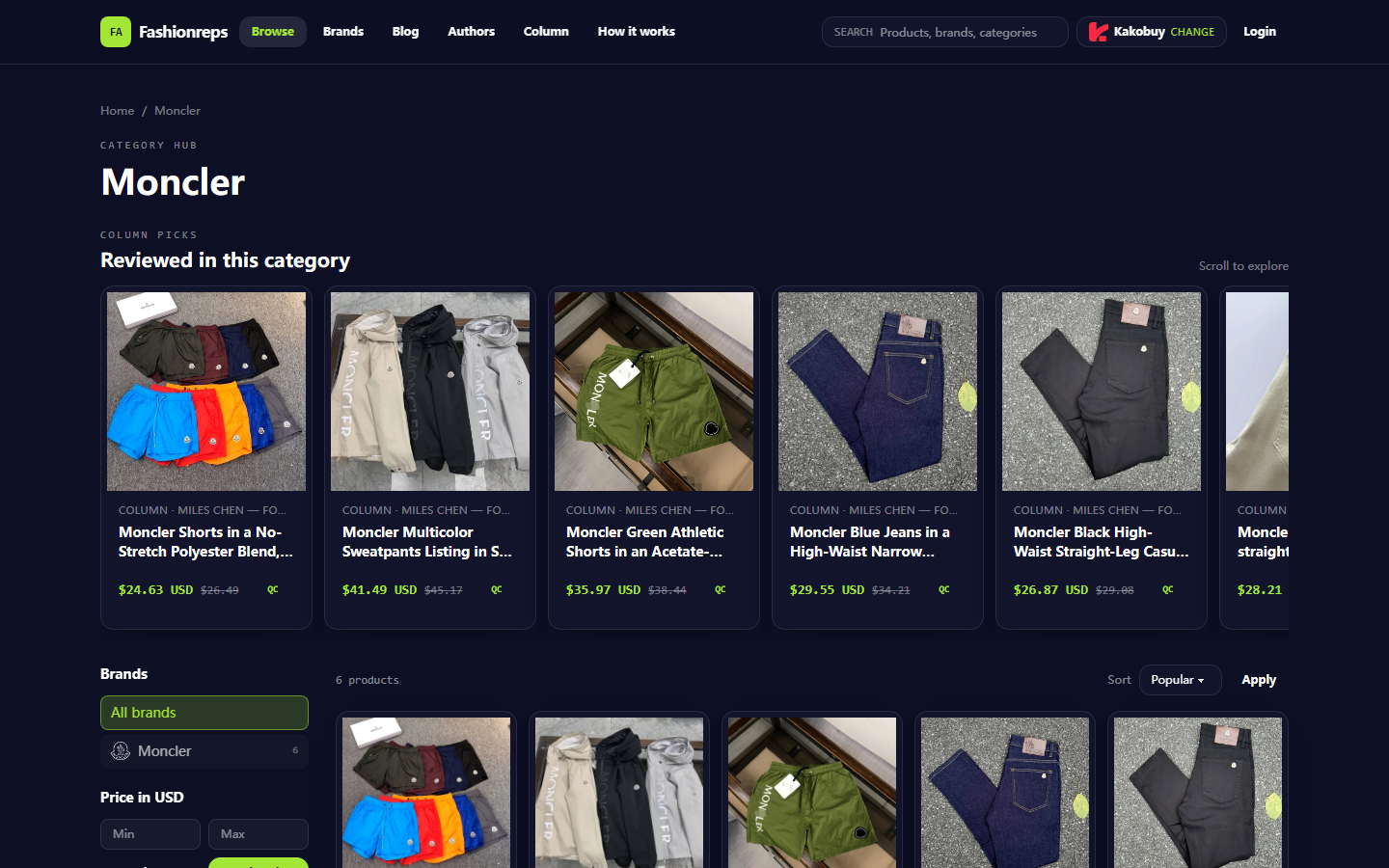
Before submitting an overseas shipping quote for this type of parcel, the most important thing is not to first compare which route is cheaper, but to first record the product, packaging, and chargeable weight as a verifiable evidence trail. This article addresses only one scenario: when preparing to hand over a Moncler fall/winter knit top to a shopping agent or logistics tool to check overseas costs, how to determine whether the information is complete, which amounts can be recorded directly, and which items must continue to be confirmed with customer service.
As of October 19, 2026, the existing on-site screenshots only show the Moncler category page and pants listings on fashion-reps, and do not provide a verifiable product page, real-time price, inventory, size chart, actual measured weight, or packaging quote for the target knit top. Therefore, this article does not fill in unverified product amounts, shipping fees, taxes, transit times, or chargeable weight. 🧾
Defining the Recording Task Before Shipping a Moncler Fall/Winter Knit Top Overseas
After reading this record, the reader should be able to complete three actions:
- Determine whether the target knit top has sufficient product evidence to proceed to cost inquiry.
- Record product amount, service fee, payment fee, packaging, shipping, and exchange rate separately.
- When evidence is insufficient, clearly identify what to ask, rather than treating estimated values as final costs.
This article does not apply to parcels that have already obtained formal carrier quotes, complete warehouse weighing records, and destination country tax settlement sheets; such cases should be based on the latest records from the corresponding orders and logistics service providers. It also does not apply to practices that reduce costs through under-declaration, splitting orders to evade taxes, or circumventing import inspections.
Checking Style, Color, Size, and Currently Visible Information on the fashionreps Product Page
First save the original record of the product page or on-site listing, including query date, page title, product images, color, size, material description, seller information, page price, and available inventory. The product title should clearly point to a knit top, not just infer from the Moncler brand category or image appearance.
The existing screenshots show the Moncler category page, which lists multiple pants entries, and does not include product details, size data, or real-time price for the target knit top. It can prove that Moncler category content exists on the site, but it cannot prove that the target knit top is already purchasable, nor support calculation of product weight or overseas costs. 🔍
If any of the following occurs on the target product page, cost settlement should be paused:
- Page redirects, blank, 404, or only tags without a clear product name.
- Product title and image mismatch, unable to confirm it is a knit top.
- Missing color, size, inventory, or material information.
- Page price without currency, query date, or applicable conditions.
- Product page unable to confirm seller or purchase entrance.
Image record:

The information in the image is only used to illustrate the visible scope of the current on-site Moncler category page, and is not evidence for the target knit top's product, weight, material, or price.
Establishing a Field Checklist for Product Amount, Service Fee, Payment Fee, and Packaging
Do not split a total price into seemingly precise proportions, nor use the price of other Moncler products to replace the knit top price. Save each field item by item according to the actual return from the order:
| Record Item | Current Evidence Status | Content to Save | Action When Missing |
|---|---|---|---|
| Product amount | Unverified | Product page price, currency, color, size, query date | Record after supplementing a valid product page |
| Shopping agent service fee | Unverified | Fee name, calculation method, whether tax or handling fee included | Confirm applicable conditions with target agent |
| Payment fee | Unverified | Payment method, rate or fixed fee, settlement currency | Based on payment page or bill |
| Packaging fee | Unverified | Original packaging, reinforcement, box change, or repackaging fee | Ask warehouse about optional packaging and charging rules |
| Product actual weight | Unverified | Weighing time, gross or net weight, unit of measurement | Request warehouse weighing record |
| Package dimensions | Unverified | Length, width, height, unit, and measurement status | Request dimensions after packing |
| Destination fees | Unverified | Country or region, postal code, route, quote time | Re-query with full address conditions |
Only when fields come from the product page, agent order, warehouse weighing record, logistics tool, or formal customer service reply should they be written as "verified". User self-estimated knit top weight can only be placed in notes and clearly marked as an estimate; it cannot be used to form a definite billing conclusion.
Recording Packaging Type, Dimensions, and Chargeable Weight Source by Destination
The chargeable weight of the knit top must be tied to a specific parcel, not to the product name. At least the following information should be recorded:
- Destination country or region, and necessary postal code.
- Selected logistics route and query time.
- Packaging type, e.g., original packaging, soft packaging, carton, or reinforced box.
- Length, width, height, and unit of measurement after packing.
- Actual weighed value, volumetric weight value, and chargeable weight shown by the logistics tool.
- Which page, warehouse record, or customer service reply provides the chargeable weight.
Without warehouse measured data, one should not directly claim that combined shipping is definitely cheaper. Combined shipping may reduce duplicate first weight or handling costs, but may also increase volumetric weight, single loss risk, or destination declared value due to larger outer box. Split shipping may increase fixed fees, but is easier to manage in terms of route restrictions, package dimensions, or single risk. 📦
When recording, separate "actual weight" and "chargeable weight". If the logistics tool charges based on the higher of actual weight and volumetric weight, save the rules and results given by the tool; if the page does not explain the calculation method, mark the item as pending confirmation.
Using Target Logistics Tool to Check Route, Currency, Fees, and Transit Time Standards
Current materials do not provide target destination, package dimensions, weighing results, route name, or logistics tool quote, so specific shipping fees, estimated transit time, taxes, or final payable amount cannot be output.
When actually querying, save evidence in the following order:
- First select a clear destination country or region, and fill in postal code if necessary.
- Enter weight and dimensions after packing, not just the product name.
- Save route name, currency, quote time, and applicable conditions.
- Distinguish estimated freight, fuel surcharge, remote area fee, insurance fee, customs duty, and destination country taxes.
- Check whether the quote applies only to a certain weight range, product category, or declaration conditions.
- Save the query result page or order record, avoid copying only a total.
Platform identity also needs to be clear: fashion-reps is used to discover product listings and view related shopping information; orders, payment, and international shipping are handled by the user-selected external shopping agent or logistics service provider. Do not treat the on-site category page as an agent order, nor treat the reference information displayed on the page as completed warehouse weighing or shipping quote.
Distinguishing Page-Visible Amounts, Calculable Items, and Customer Service Confirmation Items
Page-visible amounts usually include the price and currency displayed on the product page, but still need to confirm whether inventory, size, and price are valid at time of order. Calculable items can be self-checked when input conditions are complete, such as total product amount for multiple items, sum of known fixed fees, or checking volumetric weight according to explicit formulas from logistics tools.
Customer service confirmation items include but are not limited to: whether packaging can be removed, whether there are special packaging restrictions for knitwear, whether the warehouse can re-measure, how insurance is charged, whether the quote includes fuel surcharge, who collects destination country taxes, and what rules apply in case of return shipping or loss/damage. Without written or page evidence, keep "pending confirmation" status and do not fill in a seemingly complete number.
Recommended statuses:
- Verified: Has source, query date, and applicable conditions.
- Calculable: Formula and input values saved, can be recalculated by another person.
- Pending confirmation: Missing formal information from customer service, warehouse, or logistics tool.
- Not applicable: The field does not apply to current packaging or route.
Recording Query Date, Exchange Rate Source, and Quote Applicability Restrictions
All amounts must be saved with currency. If conversion is needed, record exchange rate source, rate date, original currency amount, and conversion result; do not mix exchange rates from different dates, nor treat displayed currency as the final deduction currency. Exchange rate conversion is only for comparison or recording; actual deduction is still subject to the agent or payment channel settlement page. 💱
It is recommended to add the following notes at the end of the evidence table:
- Last verification date of product page.
- Date of warehouse weighing and dimension measurement.
- Date of logistics quote query.
- Exchange rate source and date.
- Whether quote includes tax, insurance, fuel surcharge, or remote area fee.
- Whether quote is restricted by route, weight range, destination, and product category.
- Whether price, inventory, route, and transit time may change before ordering.
As of the recording date of this article, the above dynamic fields have not been independently verified for the target knit top in the provided knowledge materials, so they should not be written as current quotes or promised transit times.
Final Action: Use Complete Evidence Table to Decide to Proceed, Ask, or Pause
The premise for proceeding with an order is: the target knit top product page is valid, style, color, and size are confirmed; product amount and currency have a source; warehouse provides weight and dimensions after packing; logistics tool returns a clear route and quote; the standards for taxes, insurance, and surcharges are known; all records carry query dates and applicable restrictions.
Cases where you should ask first include: only category page without product page, only product net weight without package weight, only route name without quote details, only total price without currency, or quote without specifying whether taxes and surcharges are included.
Cases where you should pause include: product page inaccessible, product identity unconfirmable, price and inventory obviously outdated, destination conditions incomplete, or logistics tool quote relies on unverified weight and dimensions. Pausing does not waste this query; instead, it preserves evidence and reduces risks of duplicate ordering, duplicate packaging, or duplicate payment.
The final record should allow another reviewer to answer four questions: Is this the target knit top? Where does the amount come from? How was the chargeable weight derived? On what date, destination, and conditions is the quote valid? If any of these questions cannot be answered, the order should be kept in pending confirmation status, rather than filling in costs with guesses. ✅